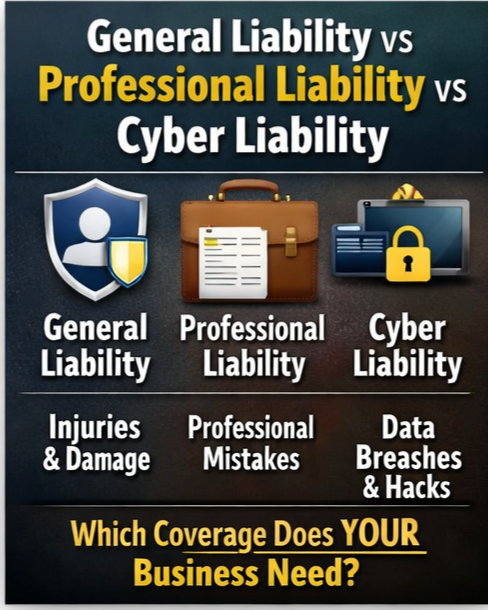
This is another high-search topic because the names sound similar — but the protection is very different.
Let’s simplify it.
General Liability (GL)
Covers:
- Bodily injury
- Property damage
- Advertising injury
Protects against physical and third-party damage claims. Learn More
Professional Liability (Errors & Omissions)
Covers:
- Professional mistakes
- Negligence claims
- Missed deadlines
- Bad advice
Example: A consultant gives incorrect advice that causes financial loss.
If your business provides advice, design, services, or expertise — you likely need this.
Cyber Liability
Covers:
- Data breaches
- Hacking incidents
- Ransomware attacks
- Client notification costs
- Credit monitoring
If you collect:
- Emails
- Payment information
- Client data
- Employee records
You have cyber exposure.
And small businesses are increasingly targeted.
Workers’ Comp Requirements in Texas
Since many business owners ask:
“What are the workers’ comp requirements in Texas?”
Texas is unique.
Private employers are not legally required to carry workers’ comp. However:
- Government contracts often require it.
- Without it, you lose certain legal protections.
- You may face higher lawsuit exposure.
In most other states, workers’ compensation is mandatory once you have employees.
What Is a Certificate of Insurance (COI)?
A COI is proof that your business has active insurance coverage.
Clients, landlords, and vendors commonly request it before allowing you to:
- Start work
- Lease space
- Participate in events
It’s issued by your insurance agent — usually at no cost.
If your agent makes getting a COI difficult, that’s a red flag.
Do You Actually Need All of This?
Not every business needs every policy.
But most businesses need more than just one.
The key isn’t buying more insurance — it’s buying the right insurance. Contact Us
If you’d like a clear breakdown of what applies to your specific business, that conversation is worth having.